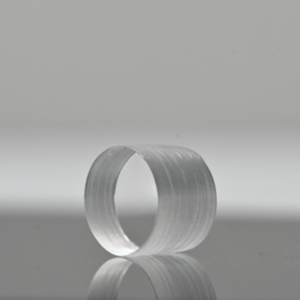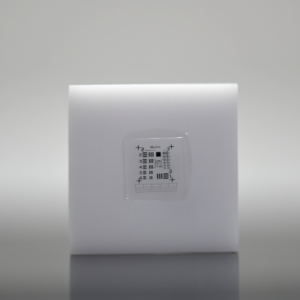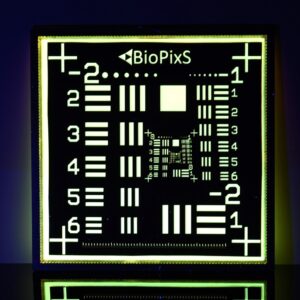

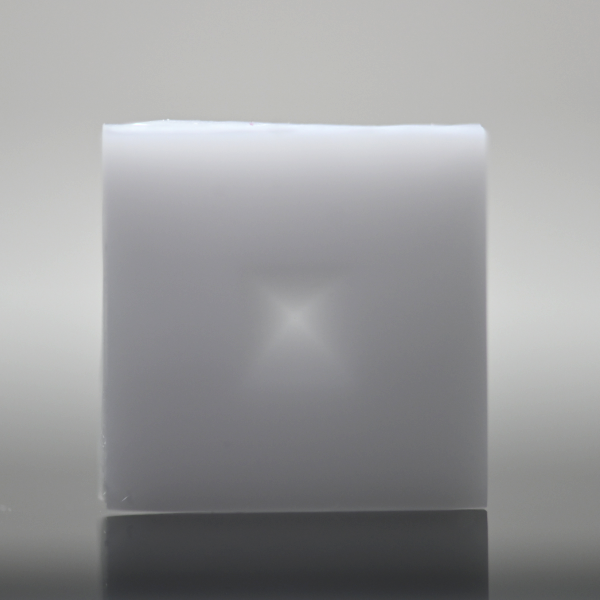
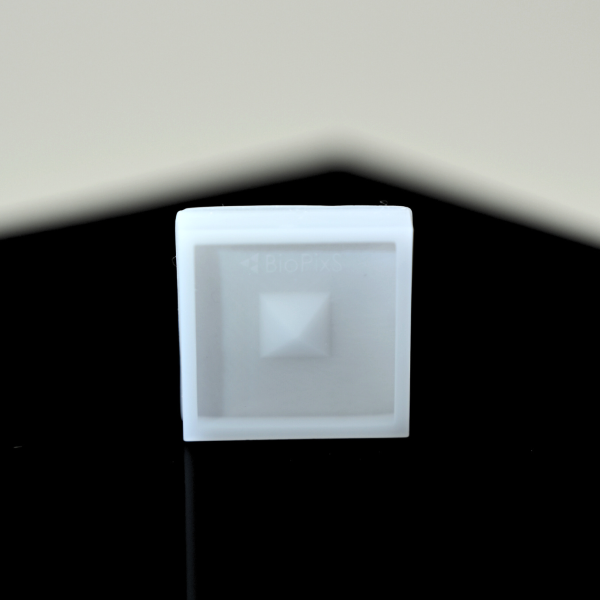

BioPixS’ OCT Pyramid test targets are advanced calibration phantoms designed to support multidimensional performance assessment of Optical Coherence Tomography (OCT) systems. These targets feature pyramid-shaped structures with high-precision step patterns (40, 80, or 120 μm pitch and 50 μm step height), embedded into an optically relevant polymer substrate.
Available in positive or negative relief configurations, these pyramid targets are ideal for testing axial resolution, field uniformity, distortion correction, focus depth, and field-of-view consistency. Their well-characterized geometry and optical properties (μa = 0.19 cm⁻¹, μs’ = 8 cm⁻¹) provide an essential platform for validating OCT performance across hardware setups and software pipelines.
Key Features & Benefits
-
Pyramid geometry with micron-scale precision: choose from 40, 80, or 120 μm base size with 50 μm step height.
-
Positive and negative configurations: enables evaluation of both elevated and recessed structures.
-
Polymer phantom substrate: mimics biological tissue with well-defined absorption (μa) and scattering (μs’) coefficients.
-
Precision dimensions: pyramid = 7 × 7 × 4.5 mm; overall phantom size = 22 × 22 × 6.5 mm.
-
Calibrated structure: enables consistent and traceable optical resolution testing.
-
Supports multiple tests: spatial calibration, distortion analysis, axial precision, focus depth, and field-of-view mapping.
-
Reusable and durable: Non-biological solid phantom can be used repeatedly without degradation.
Why Choose BioPixS OCT Pyramid test targets
-
📏 Multi-dimensional calibration: ideal for verifying system accuracy in both the axial and lateral planes.
-
🔬 Test for real-world complexity: mimics edge, slope, and depth changes like those found in biological samples.
-
📐 Distortion and focus assessment: use for evaluating system linearity and depth of field in OCT imaging.
-
🧪 Scientifically tuned optical properties: absorption and scattering coefficients tailored for OCT in the 800–1300 nm range.
-
🌍 Validated in European optics research: designed with practical system validation in mind.
-
📄 Specification sheet available: full dimensions and material parameters provided as a downloadable PDF.
Applications
-
Axial and lateral resolution testing: Quantify performance with known geometry.
-
Focus depth calibration: Test focus and focal shift across scan depth.
-
Field-of-view uniformity: Verify imaging consistency across the XY scan field.
-
Distortion and deformation analysis: Identify imaging non-linearities due to optics or software processing.
-
Algorithm benchmarking: Train and evaluate structure-tracking or segmentation tools using stepwise surfaces.
-
Research and QA: Essential for labs, device manufacturers, and algorithm developers.