
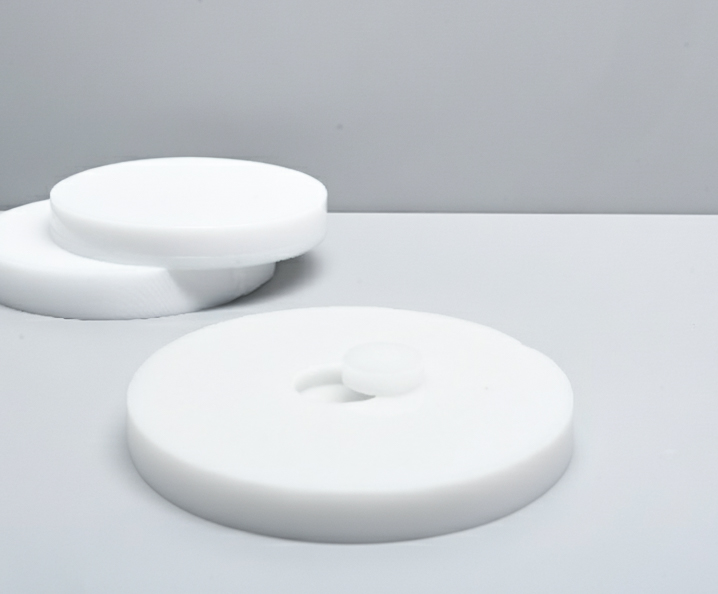
Heterogeneous optical phantoms are specialized tissue-mimicking models designed with internal inclusions that differ in optical properties from the surrounding medium. These phantoms replicate complex tissue heterogeneities — such as tumors or lesions — found in real biological tissues, making them ideal for validating biomedical imaging systems and therapy modalities like Diffuse Optical Tomography (DOT) or Photodynamic Therapy (PDT).
Developed using BioPixS’s advanced fabrication capabilities, these phantoms offer both structural realism and precisely tuned optical properties, as demonstrated in recent cutting-edge clinical research applications. Notably, our heterogeneous phantoms were featured in the design of the hybrid PDT prostate phantom published in Biomedical Optics Express (Feb 2024).
If you are looking for phantoms for fluorescence imaging system validation or phantoms for interstitial PDT dosimetry, you are in the right place!
⚠️ Not suitable for X-ray, CT, or MRI applications.
Key Features & Benefits
-
Internal heterogeneity to mimic lesions, tumors, or damaged tissue
-
Same base material throughout for structural consistency with tunable optical contrast
-
Support reconstruction algorithm validation and depth/lateral resolution testing
-
Highly customizable: inclusion size, location, geometry, and optical contrast
-
Long shelf life thanks to solid construction (polymer or solid resin variants)
-
BioPixS traceability: batch-specific optical characterization available
-
Compatible with fluorescence, DOT, multispectral imaging, and photodynamic therapy systems
-
Designed in compliance with phantom-based standardization efforts
Why Choose Heterogeneous Optical Phantoms?
-
Realistic simulations of ill tissue: Tumor-mimicking inclusions reproduce the light absorption profiles typical of cancerous or ischemic tissue
-
Validated in clinical research: We validated our phantom designs with successful fluorescence reconstruction and photobleaching studies
-
Superior reconstruction testing: Perfect for checking how your system handles complex contrast distribution
-
Alternative to animal testing: Safe, ethical, reproducible — enabling global research reproducibility
-
Custom-made for your needs: Let us know your tissue model, wavelength range, and geometry — we will fabricate accordingly
Applications of Heterogeneous phantoms
Heterogeneous phantoms are ideal for a range of biomedical optics R&D use cases:
🔬Imaging System Validation
-
DOT & Near-Infrared Spectroscopy (NIRS)
-
Multispectral & hyperspectral imaging
-
Fluorescence molecular imaging
💡Photodynamic Therapy (PDT) Dosimetry
-
Evaluate spatial PS (photosensitizer) distribution
-
Assess photobleaching effects
-
Optimize light fiber placement
-
See the use case in this Optica journal article
🛠Device Calibration & Reconstruction Algorithms
-
Spatial and depth resolution assessment
-
Lateral discrimination accuracy
-
Algorithm robustness testing in heterogeneous media
🎓Training & Education
-
Simulate clinical tumor-like environments for surgeon or technician training
-
Assist in robotic intervention planning
🧪Technical support and Traceability
All heterogeneous phantoms come with:
-
Optical property characterization (absorption and reduced scattering at chosen wavelengths)
-
BiopixS traceability codes
🔄 Comparison to multi-layer phantoms
Multi-layer phantoms, once overlapped to create a stratified structure, can indeed be consider a type of heterogeneous phantoms. However, there are some remarkable differences between the 2 types, which are summarized in the table below:
| Feature | Heterogeneous Phantoms | Multi-Layer Phantoms |
|---|---|---|
| Structure | Inclusions with variable optical properties | Stacked homogeneous layers |
| Use case | Tumor/damage simulation, DOT, PDT | Stratified tissue mimicry (skin, mucosa, etc.) |
| Customization | Size, shape, placement of inclusions | Layer thickness and optical properties |
| Imaging challenge | Simulates internal contrast and irregular structures | Simulates layered depth progression |
| Overlap | Depends on the specific customized design | Multi-layer phantoms can form heterogeneous structures when layered but lack discrete inclusions |
Heterogeneous optical phantoms can be quite complex and budget-demanding: if you need them as part of a project, we would be happy to join the project. BioPixS team has a solid expertise in European and international projects. Contact us today and let’s discuss!
👉 Looking for tissue stratification models? Explore our Multi-Layer Phantoms page!
📩 Want to replicate a real-world anatomical scenario? Let’s build it together—contact us today to start your custom design or request a quote!