
OCT test targets and phantoms
Calibrate, validate, and compare OCT systems with tissue-mimicking test targets and phantoms. Choose from multilayer, PSF, pyramid, and USAF targets to test resolution, distortion, focus, alignment, and reference stability.
BioPixS OCT test targets and phantoms are designed to help you quantify OCT performance in a repeatable way. In other words, they turn “it looks good” into numbers you can track over time, compare across instruments, or report in technical documentation.
Different OCT validation tasks require different geometries, hence this category includes four complementary standards: a multilayer target (depth validation), a PSF target (spot response), a pyramid target (3D step geometry), and a USAF target (lateral resolution and alignment). Whether you are trying to test lateral resolution or PSF, we’ve got you covered!
What these OCT targets help you test
-
Lateral resolution (USAF groups + line pairs) and practical “what can I resolve?” checks.
-
Axial / depth performance (layered structures and step geometry).
-
PSF / spot response for benchmarking optics + processing, and for tracking drift.
-
Distortion & scaling (straight features and repeatable geometry), so you can validate corrections.
-
Focus, field-of-view, and uniformity, especially when you need confidence across the full scan area.
-
Alignment & referencing, so that routine QA becomes faster and more repeatable.
Product range at a glance
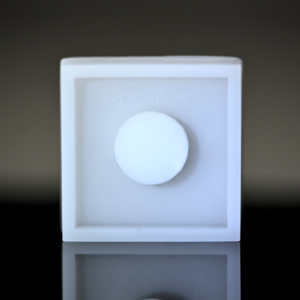
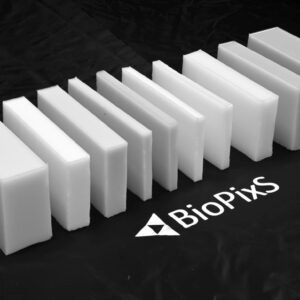
OCT Multilayer Test Targets – For depth resolution and contrast-versus-depth validation using repeatable multilayer structures.
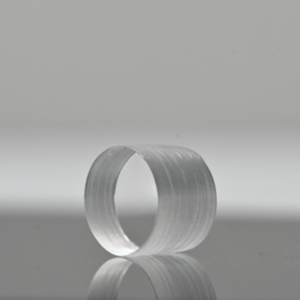
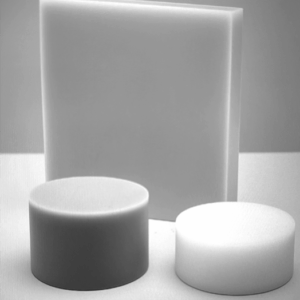
OCT PSF Test Target – For axial/lateral resolution and focus checks using FeO nanoparticle scatterers inside a polymer cylinder.
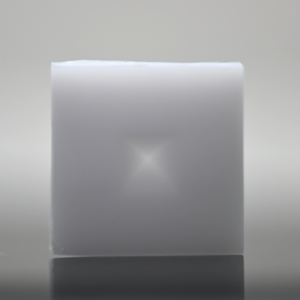
OCT Pyramid Test Targets – For resolution, distortion, reference, focus and field-of-view testing using stepped pyramid structures (positive/negative options).
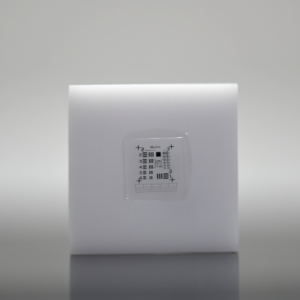
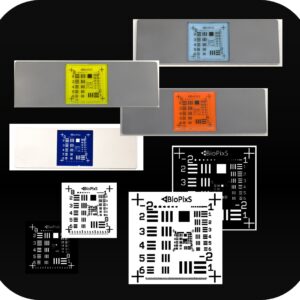
OCT USAF Test Targets – For lateral resolution, distortion, alignment and calibration using USAF Groups 2–8, PSF features, Ronchi rulings, and alignment markers (positive/negative; glossy/matte).
| Product | Best for | What you can measure | What makes it different |
|---|---|---|---|
| OCT Multilayer Test Targets | Depth and layer visibility validation | Layer separation, depth scaling, depth uniformity | Multi-layer structure for depth-oriented checks |
| OCT PSF Test Target | PSF benchmarking and stability tracking | PSF width/shape, system blur, repeatability over time | Compact cylinder; designed to isolate PSF behaviour |
| OCT Pyramid Test Targets | 3D geometry validation | Focus, FOV, distortion, spatial/axial resolution behaviour on steps | Micron-scale step pyramid geometry (positive/negative options) |
| OCT USAF Test Target (Group 2–8) | Lateral resolution + alignment + calibration | Resolution groups, Ronchi rulings, alignment, PSF features | Chrome USAF pattern + alignment markers + Ronchi (10/100 lines/mm) |
Quick selection guide
| If your main goal is… | Choose… | Why |
|---|---|---|
| Depth resolution and contrast vs depth | OCT Multilayer | Known layer count/thickness enables depth benchmarking. |
| Extract PSF / verify focus | OCT PSF | FeO nanoparticles provide point-like scatterers for PSF analysis. |
| Check distortion, FoV, focus across the scan | OCT Pyramid | 3D stepped geometry highlights non-linearity and field effects. |
| Validate lateral resolution + alignment + calibration | OCT USAF | USAF + Ronchi + markers make resolution and alignment checks straightforward. |
Typical workflows
-
Incoming QA / routine QC: scan the same region and trend key metrics over time (resolution, distortion, contrast vs depth).
-
System comparison: image two OCT systems with identical settings and then compare outputs using the same target.
-
Algorithm validation: use repeatable geometry to validate segmentation, deconvolution, distortion correction, and also focus optimization.
Why choose BioPixS OCT test targets
-
Designed for OCT validation, not generic imaging: therefore, we chose geometry and materials for practical OCT workflows.
-
Tissue-mimicking approach: many targets use phantom substrates so the measurement conditions are closer to real samples.
-
Traceability mindset: spec sheets + batch/trace codes help you document and reproduce results (useful for QA and publications).
-
A coherent set: the four products are meant to work together, so you can expand from “one check” to “full performance mapping” without changing supplier.
Showing all 4 results
-
OCT Multilayer test targets
OCT test targets and phantoms Price range: €530.00 through €998.00Select options This product has multiple variants. The options may be chosen on the product page10 layers20 layers50 layersClearGlossyMatt -
OCT Point Spread Function (PSF) test target
OCT test targets and phantoms €859.00Select options This product has multiple variants. The options may be chosen on the product page<100 nm<1 umLowhighClearGlossyMatt -
OCT Pyramid test targets
OCT test targets and phantoms €650.00Select options This product has multiple variants. The options may be chosen on the product page40 micron80 micron120 micronPositiveNegativeClearGlossyMatt -
OCT USAF test targets – group 2 to 8
OCT test targets and phantoms €720.00Select options This product has multiple variants. The options may be chosen on the product pagePositiveNegativeClearGlossyMatt