
Advanced tissue-mimicking optical phantoms
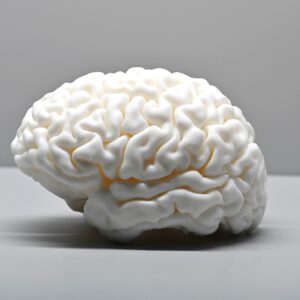
In modern biomedical optics, the demand for increasingly realistic, application-specific reference materials has given rise to a new generation of advanced tissue-mimicking optical phantoms. These phantoms go beyond traditional homogeneous standards, incorporating complex internal structures, multi-layer compositions, or customized optical properties to emulate specific anatomical, functional, or pathological features of human tissue.
This category includes two key product families:
-
Heterogeneous phantoms, ideal for imaging system validation and algorithm benchmarking under realistic spatial complexity;
-
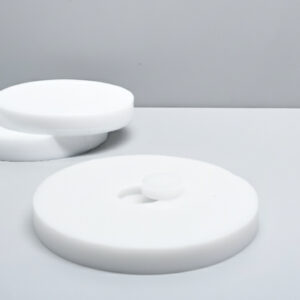
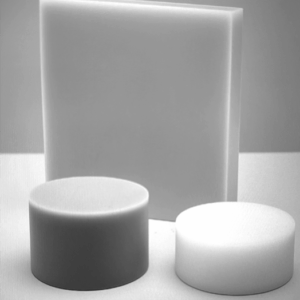
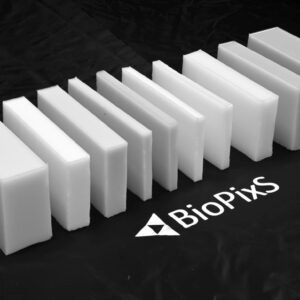
Customized homogeneous phantoms, designed with tailored absorption and scattering profiles to replicate distinct tissue types, wavelengths, or instrumentation needs.
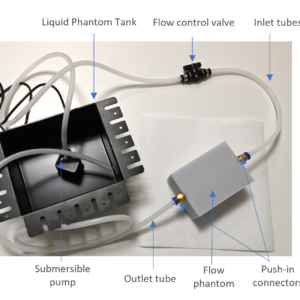
- Dynamic liquid phantom, a modulated liquid phantom for flow studies.
Whether for research, clinical prototyping, or quality assurance, these phantoms support realistic, reproducible, and traceable optical testing.
Key features of advanced tissue-mimicking optical phantoms
-
Realistic tissue simulation
Mimic absorption, scattering, and structural complexity of biological tissues. -
Tailored optical properties
Custom μa and μs’ values across NIR and visible ranges, with wavelength-specific tuning. -
Spatial heterogeneity
Enable robust testing of source-detector geometries, tomographic reconstruction, or feature detection. -
Batch reproducibility
High repeatability across samples; fabrication protocols optimised for consistency. -
Solid and hybrid formats
Options include solid phantoms but also hybrid models combining different materials. -
Application flexibility
Ideal for CW, TD, FD, DOT, DCS, fNIRS, spectroscopy, surgical light validation, brain-computer interface, and many more.
Why choose advanced tissue-mimicking optical phantoms
At BioPixS, phantom development is not a one-size-fits-all process — it’s science-driven and application-focused. Our advanced phantoms have been developed through:
-
Participation in major EU-funded R&D projects (e.g., TinyBrains)
-
Validation on multiple commercial and custom-built imaging systems
-
Close collaboration with medical physicists, optics engineers, and clinical researchers
We offer fully bespoke solutions, with in-house control of:
-
Phantom design (we are happy to use your CAD file)
-
Design wavelength and optical characterization (for NIR or visible wavelengths from 470 to 1650 nm)
-
Precision casting and quality assurance
These phantoms support your system development pipeline from bench to bedside.
Applications
| Application Area | Description |
|---|---|
| Diffuse Optical Tomography (DOT) | Assess reconstruction algorithm accuracy with phantoms that include layered geometries or inclusions. |
| Diffuse Optical Spectroscopy (DOS) | Test and validate system, assess imaging capabilites. |
| Functional Near-Infrared Spectroscopy (fNIRS) | Model depth sensitivity and signal attenuation across spatially complex tissues. |
| Frequency- & Time-Domain Systems | Use phantoms with known μa and μs’ to validate phase shift, temporal response, signal decay and overall system performance. |
| Surgical Light Validation & PDT | Test light penetration and dose distribution through layered or scattering media. |
| Quality Assurance & Calibration | Standardise measurement protocols across labs or system builds using traceable phantoms. |
Comparison table
| Feature | Heterogeneous phantoms | Customized homogeneous phantoms | Dynamic Liquid Phantom |
|---|---|---|---|
| Structure | Multi-layered, embedded inclusions, realistic tissue analogues | Uniform solid slabs or custom shapes | Multi-component structure |
| Material Type | Solid | Solid | Solid/liquid |
| Optical Property Distribution | Spatially varying μa and μs’ | Uniform μa and μs’ values (fully tunable) | Uniform μa and μs’ values for the solid component |
| Anatomical Fidelity | High — can replicate layered tissues or lesions | Moderate — geometric realism optional | Moderate — for flow studies |
| Reproducibility | Very high — batch consistency ensured | Very high — batch consistency ensured | Very high — batch consistency ensured |
| Customization Options | Inclusions, layers, topography | Optical properties, size, thickness | Dimension and location of pipe |
| Best Suited For | DOT, fNIRS, PDT, image reconstruction | TD, FD, CW calibration, DOS | DCS, modulation studies, imaging |
| Example Use Case | Testing tumour detection algorithms in DOT | Calibrating a TD-DOS instrument at 760 nm | Simulating pulsatile flow in tissue |
Showing all 3 results
-
Customized homogeneous phantoms – Tailored optical calibration solutions
Advanced tissue-mimicking optical phantoms Request Quote -
Heterogeneous Optical Phantoms for Imaging, DOT, PDT
Advanced tissue-mimicking optical phantoms Request Quote