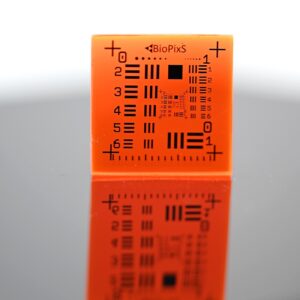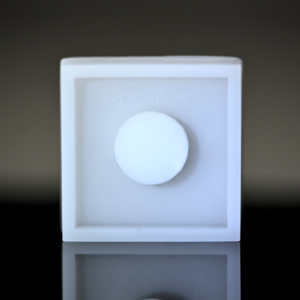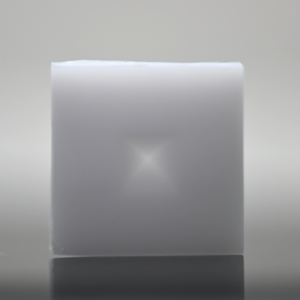

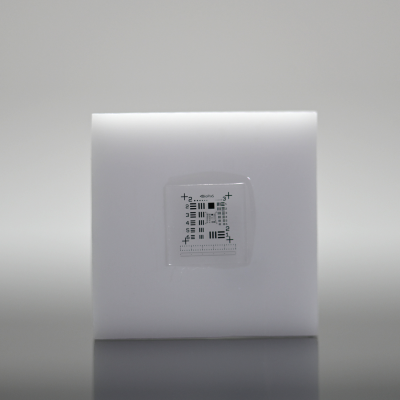
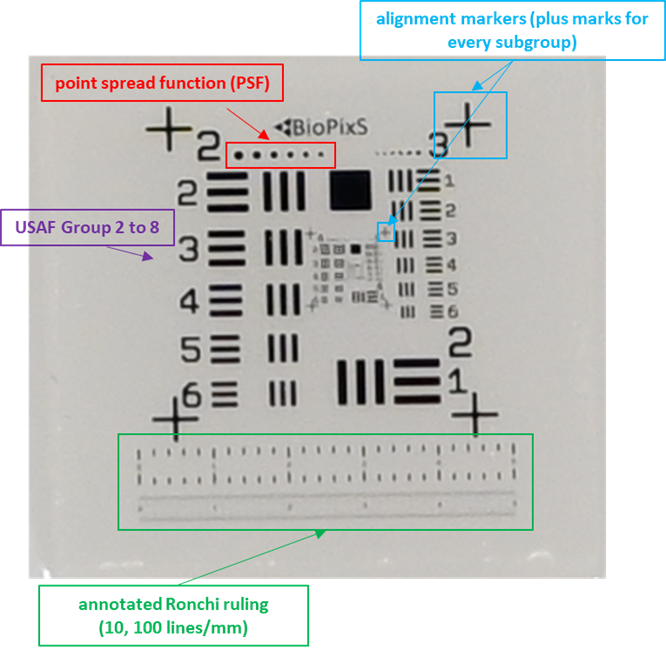

OCT USAF Test Targets are dedicated resolution and calibration standards for Optical Coherence Tomography (OCT) systems.
Each target combines a tissue-mimicking phantom substrate, a chrome USAF resolution pattern, and a protective glass cover. Thanks to this design, our targets form a robust, traceable reference for day-to-day quality control and system benchmarking.
The structure is:
-
Bottom layer: polymer phantom (thickness 2.5 mm, RI = 1.5) with well-defined optical properties (μa = 0.22 cm⁻¹, μs’ = 12.3 cm⁻¹ @ 780 nm)
-
Middle layer: chrome layer patterned with USAF 1951 Groups 2–8, Ronchi rulings (10 & 100 lines/mm), alignment markers and PSF features.
-
Top layer: glass cover (0.5 mm) for mechanical protection and optical stability.
The OCT USAF test targets are available in Positive or Negative USAF pattern and with either Glossy or Matte surface finish. Therefore, these targets provide flexible options to match different OCT configurations and imaging conditions.
Key Features & Benefits
-
Comprehensive calibration features
The target includes USAF Groups 2–8, PSF structures, annotated Ronchi rulings (10 and 100 lines/mm), and dedicated alignment markers. Consequently, users can assess multiple OCT parameters with a single device. -
Realistic phantom substrate
The solid polymer base simulates tissue-like optical properties, which enhances the realism of OCT scans. As a result, the calibration process better reflects actual imaging conditions. -
Positive or Negative USAF patterns
You may choose a Positive pattern (chrome features on a clear background) or a Negative pattern (clear features within a chrome background). Because each version behaves differently under OCT illumination, they allow users to challenge the imaging chain in complementary ways. -
Glossy or Matte finish
A Glossy finish provides stronger surface reflections, whereas a Matte finish produces more diffuse scattering. Therefore, users can select the best configuration for their system and application. -
Durable and reusable construction
Because the phantom includes solid-state materials and a protective glass cover, it is mechanically stable and suitable for long-term routine use. -
Compact and easy to mount
With overall dimensions of approximately 21 × 21 × 3 mm, the phantom fits easily on most OCT sample mounts and motorized stages.
Why Choose BioPixS OCT USAF test targets
-
🧭 Multi-function OCT calibration in a single device
Lateral resolution, distortion, PSF, alignment, and general system calibration can all be tested with one compact phantom. -
🔬 Designed specifically for OCT, not generic microscopy
Unlike standard microscopy USAF patterns, these phantoms incorporate an OCT-relevant substrate and depth structure. Therefore, they allow the system to be tested under realistic imaging conditions. -
🧪 Tissue-mimicking base with metrological features
The combination of a phantom substrate and chrome structures provides both realistic sample conditions and precise geometric standards. -
📐 Supports both development and routine QC
Ideal for R&D labs validating new OCT configurations, as well as for manufacturers and clinics performing routine performance checks. -
📄 Datasheet & traceability
A detailed specification sheet is available as downloadable pdf on this page, and it’s included in each order as well. Additionally, each batch includes a trace code for easy citation in scientific work.
Applications
-
Lateral resolution testing: use USAF Groups 2–8 to determine minimum resolvable line widths and validate lateral resolution across the field.
-
Distortion and scaling calibration: compare measured line spacing and feature geometry to nominal values to check for geometric distortion or scaling errors.
-
System calibration & reference imaging: use the target as a stable reference to monitor performance over time (baseline vs. follow-up scans).
-
Alignment and registration: alignment markers support beam alignment, scan centre calibration, and registration between different imaging sessions or modalities.
-
PSF characterization and algorithm development: PSF features and line patterns support quantitative characterization of system blur and evaluation of deconvolution or sharpening algorithms.
-
Training & documentation: ideal for teaching OCT concepts (resolution, distortion, alignment) and for generating standardized figures for reports and publications.
Discover our full range of OCT test targets and phantoms here!