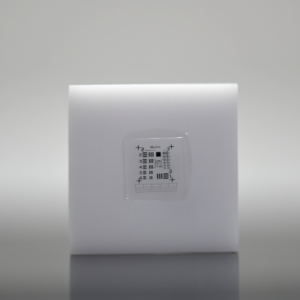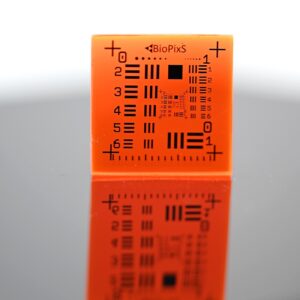

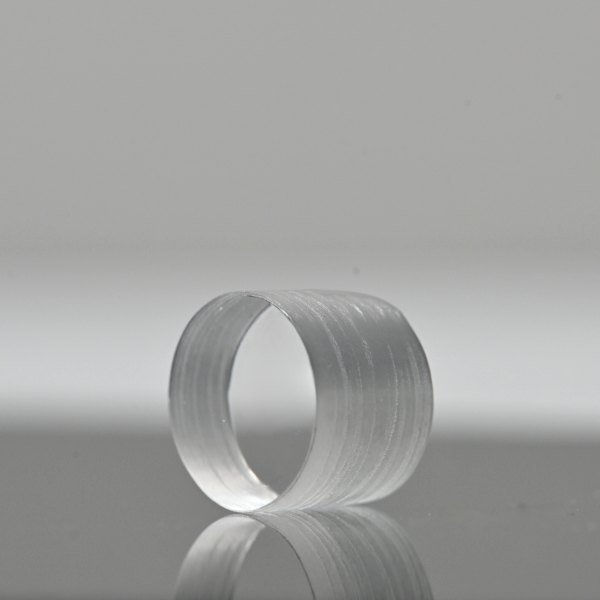
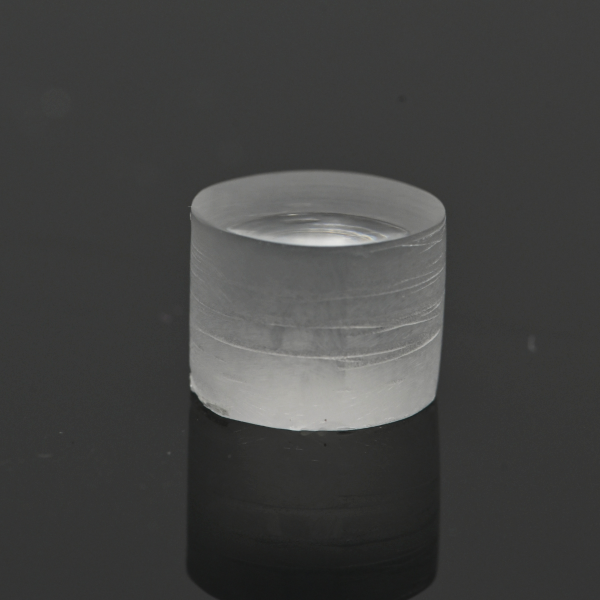
The OCT Point Spread Function (PSF) Test Target from BioPixS is a precision-engineered cylindrical phantom designed to facilitate quantitative evaluation of OCT system resolution. Unlike layered phantoms, this target contains no stratified background structure, instead, it consists of FeO nanoparticles homogeneously suspended within a transparent polymer matrix.
With its clean geometry (10 mm diameter × 10 mm height) and uniform particle dispersion, this phantom allows researchers and device developers to accurately extract axial and lateral PSF profiles, making it ideal for benchmarking system optics, algorithm performance, and optical alignment.
Not only this phantom allows to test axial and spatial resolution of the OCT system, but our PSF phantoms also come with different concentrations and nanoparticle sizes to meet the testing requirements of a wide range of OCT systems.
Key Features & Benefits
-
Polymer cylinder phantom providing a clean PSF response.
-
FeO nanoparticle suspension offers distinct scattering centers for precise PSF extraction.
-
No multilayer structure avoids interference from layered geometry—ideal for isolating system resolution performance.
-
Quantitative PSF mapping for both axial and lateral resolution validation.
-
Robust cylindrical design ensures mechanical stability and consistent imaging results.
-
Ready-to-use with no special preparation or handling required.
-
Optimized for OCT systems in the 800–1300 nm range (common biomedical wavelengths).
Why Choose BioPixS OCT Point Spread Function (PSF) test targets
-
🔍 Pure point-spread evaluation: no background structures, just nanoparticle scatterers in a clear matrix.
-
🧪 FeO nanoparticle design: chosen for optical scattering properties that match OCT signal analysis requirements, available in 2 variants.
-
🧱 Solid polymer material: durable, non-degradable, and optically stable.
-
📊 Ideal for benchmarking: enables accurate comparison between OCT systems or configurations.
-
🌍 Designed within leading EU biomedical optics experts: combining academic rigor with practical device needs.
-
📄 Spec sheet available: includes dimensions, particle density, and material properties.
Applications
-
Point Spread Function (PSF) measurement: extract full-width at half-maximum (FWHM) in axial and lateral dimensions.
-
OCT system calibration: evaluate focus, resolution, and beam alignment.
-
Image processing validation: benchmark deconvolution or PSF-based enhancement algorithms.
-
Cross-platform comparison: standardize testing across different OCT devices or configurations.
-
Optical component QA: confirm lens or scanner performance by assessing PSF consistency.